
I like to keep my situational awareness Spidey-sense in good working order.
I honed my read-the-room skills while working in retail, which can be a surprisingly hectic and complex workspace. You learn to quickly size people up, gauge their sense of urgency, and keep an eye on your doors and corners.
Exercising your nervous system like that on a daily basis stores the patterns in the body, like muscle memory. As a result, I tend to notice people, especially the needy, the confused, and the flustered.
Instead of sleep-walking through the aisles George A. Romero style, I noticed a guy in the grocery store the other day holding a cleaning product in his hand. He was frozen in time, mesmerized by the enormous selection of cleaning products in front of him. The dreaded wall of choice had him in its industrial strength grip.
They (yes, the ominous and ever-present capitalized “They”) engineer confusion by throwing up a wall of products that gives you so many options your brain just checks out. If you stare at it long enough, you become a shopping zombie. With slightly different ingredients X slightly different sized bottles X slightly different pricing, it’s maddening.
You can’t do the math in your head and all you want to do is move on to the produce section, grab some lettuce, and get home. Add to that the marketing speak on each bottle and slightly different use cases and it’s a formula for a trip to the rubber room.
Life is too short to spend it in the grocery store as a zombie or the rubber room, so I decided to shake him up a little and give him a nudge. I pointed out the prices had almost doubled in the last 5 years. That snapped him out of it for a second and he agreed (money-talk is a good virtual slap in the face).
I mean, $6.49 for a bottle of chemicals and water? Come on. It’s almost like they’re price gouging or something.
He held up the product and said he was looking for a cheaper alternative. He was sure he’d seen it a minute before, somewhere in that wall of cleaning products in front of him. He knew it had “oxy” in the name, but his dream product was invisible to him, hidden in plain sight.
I accepted the challenge, jumped in with fresh eyes, and easily spotted the product he had been blind to for the last few minutes. He made the swap and went on his way, no doubt trying to shake off the fact that he’d just been a victim of overwhelm by the over abundance of choice.
And that’s how I often feel when I have writer’s block. The thoughts were there a minute ago, but I see them clearly enough to get them on the page.
I’ve been reading a lot about writer’s block lately (so I can avoid writing, of course) and it seems there are several camps. Here are some of the opinions on this:
“Writer’s block doesn’t exist.”
“Writer’s block is procrastination in disguise.”
“I don’t believe in writer’s block.”
Have you ever had a 20-minute staring contest with a blank page? I have, and like Fox Mulder, I believe.
Some true believers have opinions on the cure as well. Some writers say the cure is as simple (and as complex) as boredom. Other fellow members of the keyboard clan try to avoid or escape the clutches of the dreaded dead head space with writing routines, all night writing sprint sessions, or going for a walk.
Some try to preempt it by sitting in the same spot at the same time every day and drowning it with their favorite beverage. Some use AI and some use techniques like these.
Are You Empty? Or Too Full?
Anne Lamott reframed writer’s block as emptiness. To her, writer’s block is often a misnomer. If the words don’t flow? Your creative well is empty. She suggests writers go pay attention to the world around them (the color of a flower, for example). This refills the well.
Wait, no, that doesn’t make sense. I go from concentration constipation to digital diarrhea and back again in the course of an hour. Maybe my own personal brand of blockage is bipolar? Not certain, but it’s not emptiness.
For me, it’s the opposite. Ideas are there, somewhere, I just can’t articulate them. Blockage is more like overload and overwhelm. Just like the guy who couldn’t see the cleaning product on the packed shelf in front of him, too many choices equals a lack of clarity.
Can Your Muse Come Out to Play?
Here’s where I contradict myself as I’ve developed an alternate theory of the crime. When the teacher asks the class a question and no hands go up, what are the students afraid of? The criticism that might come from being wrong, right?
What if writer’s block is your creative side hiding from potential criticism? In other words, your muse is afraid to come out and play. Stage fright without the stage.
In any case, after some back and forth with my other self, I realized it doesn’t matter.
Whether it’s emptiness, overwhelm, or your muse’s performance anxiety, what you need at those times is a slap upside the head brain reset. I’ll describe what I mean by that, but first, I set the stage for the rest of this with my previous articles: your best ideas are hiding in the shower and break out of Mediocrityland.
Here’s what you need to know…
To Solve the Problem, Stop Trying
As Amos said in The Expanse:
Sometimes you gotta stop thinking about somethin’ to figure it out
I want to systematize everything I can. Aspirationally ambitious? Yep. Unrealistic? Sure, but there are massive benefits to be had, and I can at least try.
Why? Because randomness, as useful as it can be, is the enemy here. Consider the following concept:
The ideas that matter usually show up when you stop chasing them.
-Jerry Keszka
Yes, that’s true and takes all the pressure off. And it works:
The problem? It’s random.
You can plant your butt in a cafe sipping coffee looking at a beautiful view for 365 days in a row hoping for some random inspiration and in a year, nothing meaningful about your situation will have changed.
But what if you could take some of the randomness out of it? What if you could make the “ideas that matter” flow more consistently? That’s where I want to live, or at least I feel compelled to try.
The advice you’ve heard to go touch grass or go for a walk is not bad advice. You should probably do those things if it moves you. But the results are totally random. To rely on randomness is to rely on hope, and hope is not a strategy.
You might come back from your wild mini-adventures with good ideas. You might even come back with the exact answers you need. You might win the lottery.
Boredom is Not the Cure
You may have heard boredom is the cure for the overloaded modern brain. Judging by number of Likes, that’s a great sound bite but my question is, how do you induce boredom in any reliable way?
It’s All Dog Saliva to Me
Pavlov’s dogs salivated when the bell rang because he conditioned them by ringing the bell every time the food was served. When you hit a creative block, you need a way to get your muse salivating on demand. A way to trigger your aha! moments. But first, here’s something to chew on…
Creativity has Stages
In 1926, Graham Wallas, a fellow systems-freak and a founder of the London School of Economics defined 4 distinct phases of creativity in The Art of Thought:
Preparation.
Incubation (the shower effect—where your muse wakes up and smells the coffee).
Illumination (the aha! moment).
Verification.
When we create the right conditions to trigger the aha! moments, we don’t need to wait around to become bored. It’s the 2 middle stages (incubation and illumination) we’re focused on. That’s where your muse can finally enter the convo with off-the-wall ideas and connections your logical brain would never make in a bazillion years.
You can think of this as the classic “left brain vs. right brain” model, the logical vs. creative, but that’s an oversimplification. Instead of this being about 2 competing hemispheres, it’s about 2 competing networks in your brain:
The Executive Control Network (ECN) — Dominant when you’re focused and concentrating.
The Default Mode Network (DMN) — In play when your mind wanders, allowing your muse to fully come alive.
To unlock your muse, you want to trigger mind wandering which flips the on-switch on the DMN. To do that, you have to get to stage 2 (incubation). Congratulations! At that point, you’re no longer actively trying to solve the problem.
During incubation, you let go of concentration. Your muse works in the background to work the problem. Next comes your “aha!” moment (illumination). Like the great Archimedes, who realized the volume of water spilling out of the bath had to be equal to his own body’s volume, suddenly it all comes together.
Your brain realizes it has a brilliant idea. In the spirit of Archimedes, you run through the streets naked shouting “Eureka!” (“I’ve found it”). Well, minus the naked part, I hope.
It’s one of life’s many ironies that in order to solve the problem you need to stop trying to solve the problem.
The obvious question is: how do you encourage this process of fluid idea generation and problem solving? And, in the extreme case…
What do you do if your muse has fallen, and it can’t get up? Sometimes, the proverbial creative well won’t pump it’s magical water.
The Great Brain Reset
There’s a way to invoke the shower effect through conditioning, much like Pavlov’s experimental dogs. It’s a more reliable way to trigger the aha! moment you get on a walk. It’s deceptively simple. So simple it’s absurd and you might be tempted to skip it.
It works like this: You select a “mindless“ task (stretching, washing dishes, folding laundry, etc.). The next time you feel creatively stuck:
Write down the problem you’re trying to solve (don’t skip this).
Immediately do your specific, pre-chosen mindless task for 10 minutes.
Record whatever solutions come to mind.
This kicks the incubation effect into gear with a specific goal, making it more likely solutions come to you. It’s not foolproof. It may not produce the answer you want right away (or at all), but it’s more reliable than waiting for boredom to take over. It’s also better than sitting in a chair for however long it takes for the creative floodgates to open.
The more you do this, the more your nervous system gets used to it. Consistently do this every time you hit a creative wall and it will become easier. Practice compounds.
More things are stored in the body, Horatio, than are dreamt of in your philosophy.
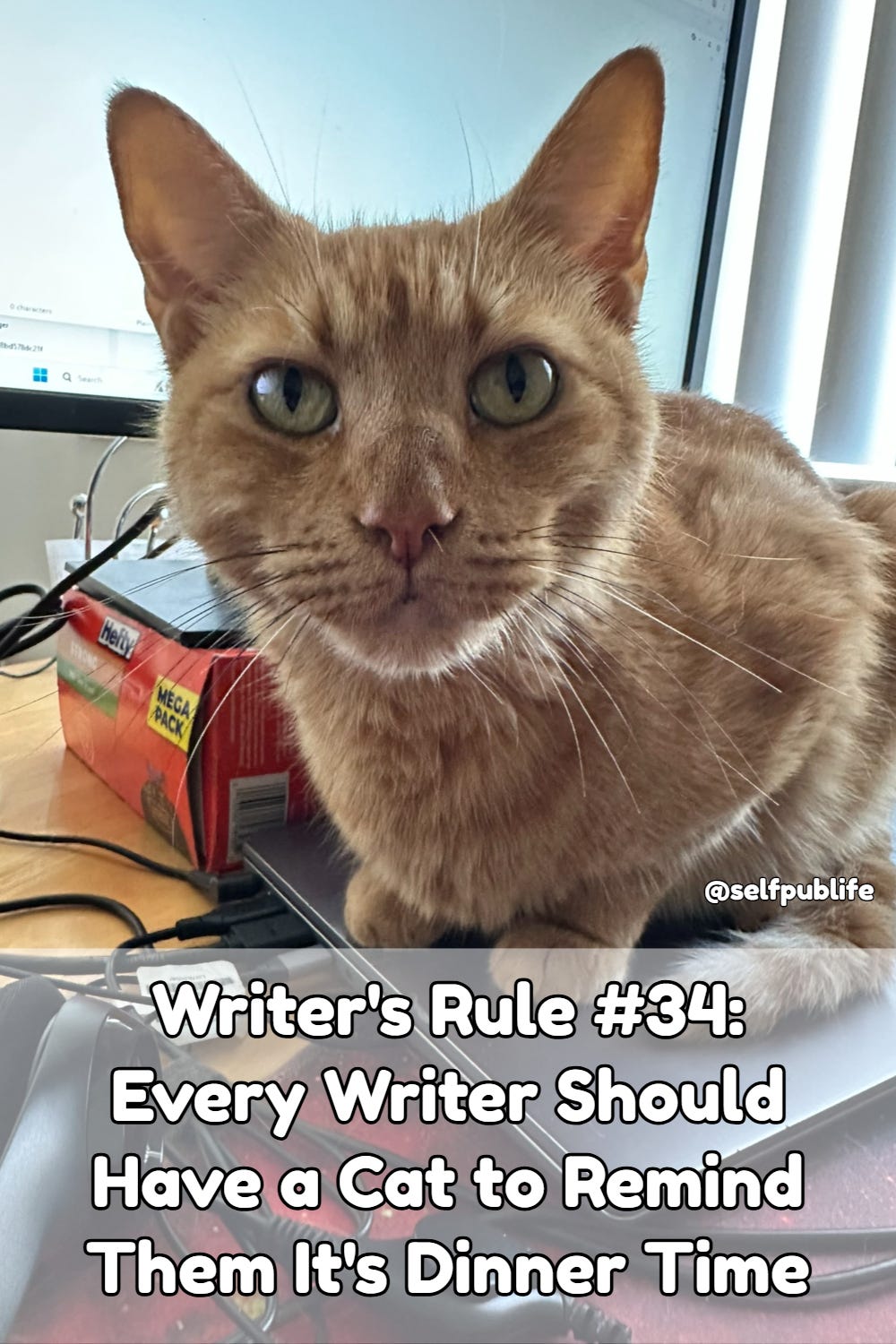
Just as with my cat, whose internal clock reminds us both when his dinner time is, your biology gets used to patterns. It’s like muscle memory. The more you do this, the more your muse will show up, even when you don’t ask. Ideas start to flow at all times, and solutions to problems come to you throughout the day.